
Aluminum Compressed Air Piping: When Replacing Black Iron Actually Pays for Itself
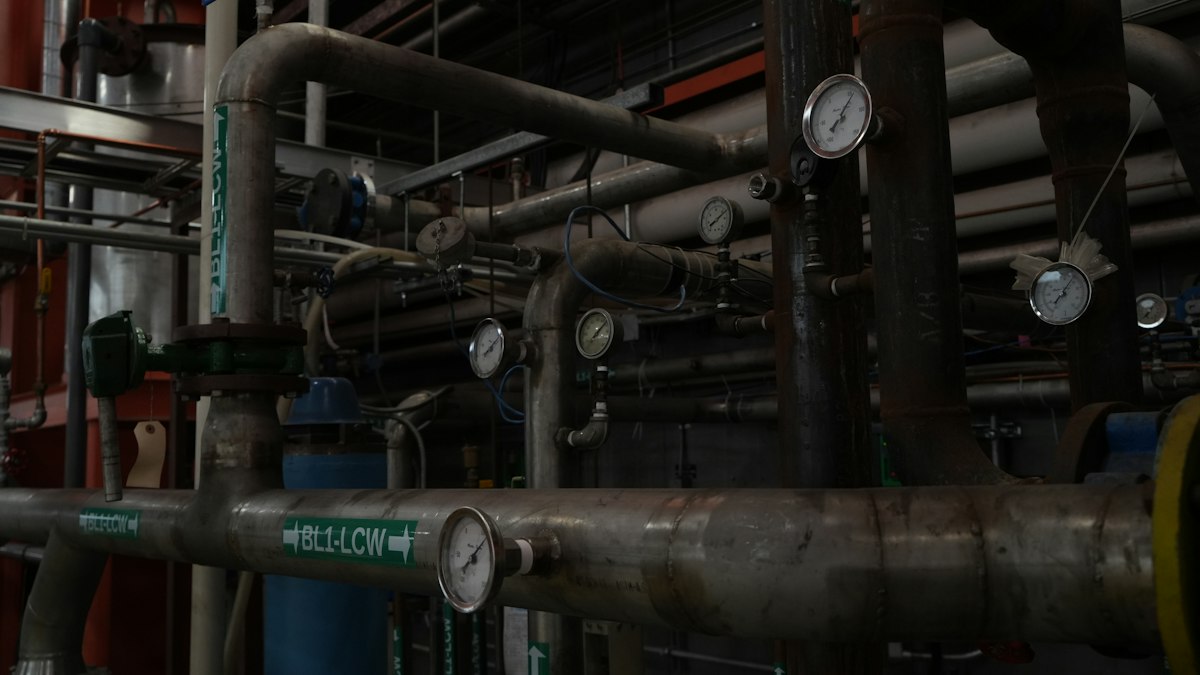
Replacing black iron with aluminum pays for itself when your plant has at least one of three measurable problems: a pressure drop between the compressor and the point of use that exceeds the 10 percent limit the Compressed Air and Gas Institute (CAGI) and the U.S. Department of Energy (DOE) both use as the design ceiling, a leak load you have measured and cannot get under control through repair, or internal rust and scale that is contaminating instrument or process air. It also tends to pay when the plant is about to relocate lines or add a section anyway, because the cost of the change is partly sunk.
It does not pay when the system is small, dry, and holding pressure; when your leak survey comes back under the 5 to 10 percent range CAGI calls healthy; when the plant is moving in two years and the piping stays behind; or when you already have stainless, which keeps its smooth bore and does not corrode. In those cases, fix the leaks you found and keep your money. Here is how to prove which case you are in.
Start with the pressure profile, not the pipe
The DOE sourcebook states that "for every 2 pounds per square inch (psi) increase in discharge pressure, energy consumption will increase by approximately 1 percent at full output flow." CAGI's handbook states the same relationship in the other direction: "a 2-psig change in system pressure requires a 1% change in the compressor power required" for positive displacement compressors.
Every psi lost in the piping is a psi you make up at the compressor, all year.
Measure it before you believe it. DOE Tip Sheet #4 defines pressure drop as "the reduction in air pressure from the compressor discharge to the actual point of end use" and recommends a pressure profile: gauges at the compressor discharge, after the dryer and filters, and at the farthest points of use. Log it through a full production shift. If the loss is under 10 percent of discharge pressure and the filters and dryer account for most of it, new pipe will not fix your problem. Clean filters will.
Where black iron loses pressure over time
CAGI's handbook states that "steel pipe will rust in the presence of humidity and liquid water," and that "rusting will increase the friction factor of the piping surface." A black iron system that met its pressure drop budget 20 years ago may not meet it now, because the bore is smaller and rougher than it was on day one.
The same chapter notes that aluminum's extrusion process "imparts a very smooth, low-friction internal wall" and that aluminum and copper are "corrosion resistant, so they retain their low friction qualities." Atlas Copco's engineering specification for AIRnet makes the matching claim for that product: "The low friction factor of aluminum and stainless, and the seamless connections minimize pressure drop." That is a manufacturer statement. What you can verify independently is your own pressure profile.
Fittings count too. CAGI states that "the more turbulence that the fitting or valve creates, the greater the resistance to flow and the greater the pressure drop," and gives equivalent pipe lengths for elbows, tees, and valves in Table 4.15.
Leaks: measure yours, do not borrow a percentage
DOE's leak fact sheet says a plant that "has not been well maintained will likely have a leak rate equal to 20 percent of total compressed air production capacity," while "proactive leak detection and repair can reduce leaks to less than 10 percent of compressor output." DOE's tip sheet puts leaks at "often wasting as much as 20%-30% of the compressor's output." CAGI says "a healthy air system should not leak more than 5 to 10% of its air supply, but it is not uncommon to see leaks in air systems exceeding 30%."
Those are ranges across many plants, not your number. Get yours with the DOE load/unload method: with all production off, Leakage (%) = (T x 100) / (T + t), where T is on-load time in minutes and t is off-load time. CAGI's sizing FAQ describes the same job with a flow meter on the main discharge line, or by timing pressure decay from the unload point with the compressor off.
Then walk the line with an ultrasonic detector and tag every leak. DOE lists "pipe joints, disconnects, and thread sealants" among the most common leak locations, alongside couplings, hoses, fittings, regulators, and traps. If most of the leak load is at hoses, quick disconnects, and FRLs, new hard pipe will not touch it. If a large share is at threaded joints in the mains and drops, the pipe is the problem.
Atlas Copco describes AIRnet's connections as "leak-resistant" with "double o-rings and bite ring grips." Do not convert that into a savings percentage. Convert it into a survey: measure before, measure after, and file both numbers.
Air quality: rust in the pipe ends up in the tool
ISO 8573-1:2010 is the current edition of the standard that "specifies purity classes of compressed air with respect to particles, water and oil independent of the location in the compressed air system at which the air is specified or measured." The words that matter are "independent of the location." Clean air leaving the compressor room does not guarantee that class at the tool if the pipe between them is shedding rust scale.
If you run instrument air, paint lines, packaging, food or pharma contact, or oil-free compressors, this is often the deciding factor rather than energy. CAGI notes that for oil-free compressors, "corrosion-resistant piping should be used as there is no lubricant carryover." A shop running impact tools off a lubricated compressor has almost no air quality case for new pipe.
Installation: what does not happen with aluminum
The AIRnet engineering specification states "No welding, gluing or crimping is required." The installation guide shows cut, deburr, mark, lubricate, and insert, with pipe clips no more than 2.5 m (8 ft) apart and one within 0.5 m (20 in) of every fitting.
That matters for downtime, and for hot work. Under OSHA 29 CFR 1910.252, cutting or welding requires inspection and authorization by "the individual responsible for authorizing cutting and welding operations," "preferably in the form of a written permit," a fire watcher when combustible material is "closer than 35 feet (10.7 m) to the point of operation," and a fire watch "for at least a half hour after completion." Note that the AIRnet guide warns that "cutting, deburring and assembly of AIRnet pipes may create sparks," so run your own hot work assessment.
Modularity is the last piece. Per Atlas Copco, "AIRnet Aluminum fittings and pipes can simply be removed, reconfigured, reassembled, and reused after they have been disassembled." If your plant relocates a cell every year, the value is in the second and third moves. If nothing has moved in a decade, weigh that benefit at zero.
The sizing method you can run yourself
Whether you replace or extend, size pipe with the CAGI method. Inputs: flow (cfm), pressure, run length including fitting equivalent lengths, and an allowable pressure drop. CAGI's limits: total drop from compressor to point of use no more than 10 percent of discharge pressure; distribution velocity not over 1,800 ft/min (30 ft/s); mains and headers at or below 1,200 ft/min (20 ft/s) so condensate is not carried into the airstream; branch lines over 2,000 ft/min held to 50 ft or less. Read psi loss per 1,000 ft from CAGI Tables 4.5 through 4.9 at your operating pressure, add fitting equivalent lengths from Table 4.15, and check the total against your budget. Pressure drop rises with the square of flow (Psid2 = Psid1 x [cfm2/cfm1]^2), so size for the plant you expect in five years. CAGI also recommends a loop layout.
The one-page case
Put four measured numbers in front of your plant manager: compressor discharge pressure, pressure at the worst point of use during production, leak percentage from the load/unload test, and the air quality class your process needs. If the pressure gap is over 10 percent after clean filters, if leaks concentrate at pipe joints, or if rust is reaching a process that cares, the aluminum case writes itself. If not, write "no" on the page and go fix the hoses. That is a good outcome too.
Sources
- CAGI, Compressed Air and Gas Handbook, Seventh Edition (January 2021), Chapter 4: Compressed Air System Design (10 percent pressure drop ceiling; leak percentages; pipe materials; velocity limits; Tables 4.5 to 4.9 and 4.15; looped systems)
- DOE, Improving Compressed Air System Performance: A Sourcebook for Industry, Third Edition, Fact Sheet 4, Pressure Drop and Controlling System Pressure (2 psi to 1 percent rule; 10 percent design target, verified verbatim)
- DOE, Compressed Air Tip Sheet #4 (August 2004), pressure drop definition and the pressure profile method
- Atlas Copco, AIRnet Aluminum Compressed Air, Compressed Gas, Vacuum and Inert Gas Piping System, Engineering Specifications (US)
- DOE, Improving Compressed Air System Performance, Second Edition, Compressed Air System Leaks fact sheet (leak rates, common leak locations, load/unload leakage formula)
- DOE, Compressed Air Tip Sheet #3 (August 2004), leaks wasting 20 to 30 percent of compressor output
- CAGI, Sizing FAQ: estimating the leak load of your system
- ISO 8573-1:2010, Compressed air, Part 1: Contaminants and purity classes (Edition 3; current, with a revision under development)
- Atlas Copco, AIRnet Installation and Assembly Guide (document 2935 0189 20, December 2017)
- 29 CFR 1910.252, Welding, cutting and brazing, general requirements, via eCFR
- CAGI, Technical Brief on Pressure Drop
All sources retrieved and independently verified September 2026.
Run the numbers first.
If your pressure profile and leak survey point at the piping, Stateside can size an AIRnet aluminum layout from your flow, pressure and run lengths as an authorized Atlas Copco and AIRnet distributor. Send the four measured numbers above and a rough plant sketch, and we will work the CAGI method with you. If the numbers say keep the iron, we will tell you that.
Send Us Your Numbers →