
Aluminum vs. Black Iron vs. Copper for Compressed Air: The Method for Picking Pipe You Won't Regret in Year Seven
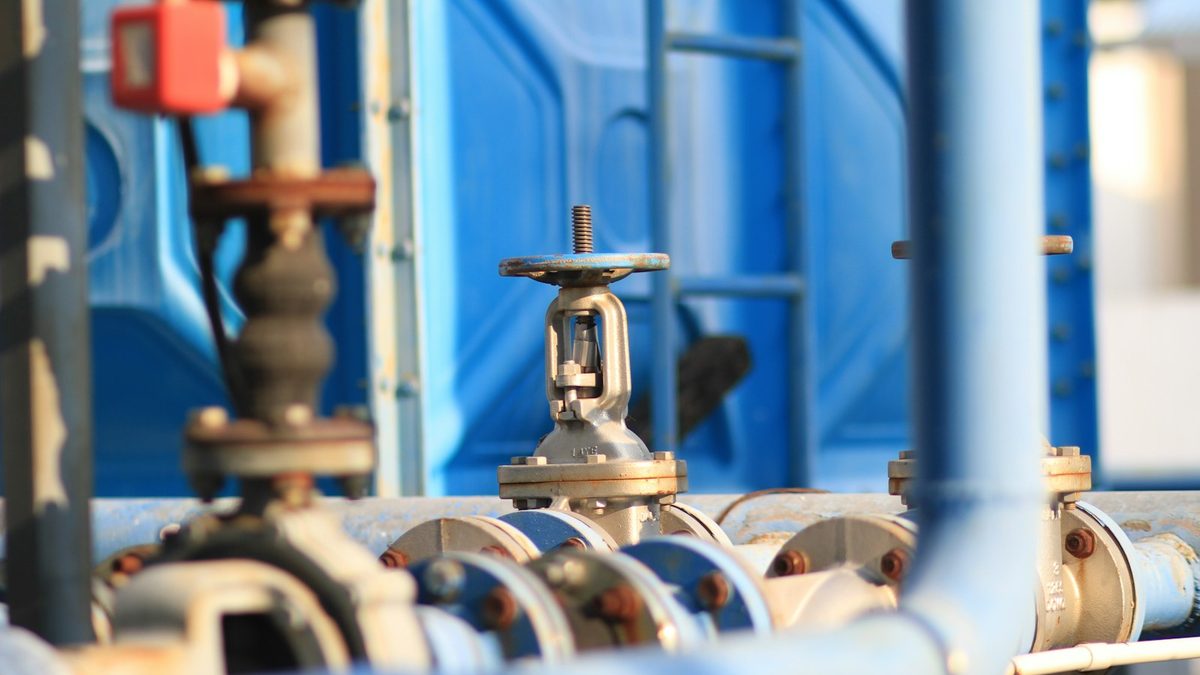
Somebody hands you three quotes for a new compressed-air main — black iron, copper, aluminum — and the numbers on the quotes are the least useful information in the room. Not because first cost doesn't matter, but because a compressed-air distribution system is judged in year seven, not at commissioning, and the things that decide year seven are how the inside of the pipe behaves over time, how hard the system fights you when the plant layout changes, and what it costs to hang from your structure. CAGI — the Compressed Air and Gas Institute — puts the stakes plainly: the piping system "is the lifeline and connection between the compressor system and the demand side of the plant"; properly sized, it "delivers the desired quality of compressed air at the proper pressure to each point of use," and improperly sized, "it will create pressure drop and starve users for air."
CAGI's list of the popular materials runs six deep — "Black iron (steel), galvanized steel, copper, plastic, aluminum, and stainless steel" — with the immediate warning that "Each has advantages and disadvantages, but they are not at all equal." So here's a method: six engineering criteria, scored before anyone's quote gets opened. (One safety note off the top, from the same CAGI FAQ, because it ends a few conversations early: "Some plastics (notably PVC) can be degraded by compressor fluids and sunlight. Rupture of PVC piping is possible." PVC doesn't make it to the scoring sheet.)
Criterion 1: Pressure drop — and what the inside of the pipe looks like in year seven
Two numbers hide inside "pressure drop." The first is as-installed drop, which is mostly a sizing question. The design target, per the DOE/Compressed Air Challenge sourcebook: a properly designed system "should have a pressure loss of much less than 10 percent of the compressor's discharge pressure, measured from the receiver tank output to the point-of-use."
The second number is the drift — what the drop becomes as the internal surface changes over the system's life. The Compressed Air Challenge's distribution-piping guidance states the mechanism: "Any type of obstruction, restriction or roughness in the system will cause resistance to air flow and cause pressure drop." CAGI's material comparison is qualitative but direct: "Some (copper, aluminum and plastics) are smooth and have less pressure drop" — the ferrous options are the ones whose internal surface can degrade. (No primary source publishes a side-by-side quantitative friction comparison for these materials in air service, so this article won't invent one; the qualitative statement is what the trade association publishes.)
Why the drift costs real money: the usual compensation is raising discharge pressure, and per the same CAC guidance, every 2 psi of discharge pressure costs approximately 1% in energy at full output flow — and with unregulated usage commonly running 30–50% of demand, the combined effect reaches about 1.6–2% per 2 psi. That penalty compounds against an industrial electricity rate that's already forecast higher. One caution before you blame the pipe, though: the same guidance shows how often distribution piping gets misdiagnosed — its worked example is a regulator set at 85 psig behind a filter and regulator dropping 20 psi, which needs at least 105 psig upstream no matter what the header is made of. Measure where the drop actually is before you re-pipe anything.
Criterion 2: Corrosion and downstream air quality
Compressed air leaves the aftercooler and moisture separator typically saturated, and as it cools further in the distribution piping, more water condenses — and that condensate, per the DOE/CAC sourcebook, causes corrosion and contamination of point-of-use processes. CAGI connects the corrosion back to criterion 1: "Corrosion could cause restrictions or rough internal surfaces, thus impacting the flow of air through the piping system," and of the material set, "Some can rust and add contaminants." This is the criterion where ferrous pipe carries its structural disadvantage: the corrosion products end up either roughening the pipe wall or traveling downstream into your filters, tools, and product.
Design practice mitigates — it doesn't repeal. The sourcebook's condensate discipline applies to every material: slope headers away from the compressor with drop legs and drain points, and take branch connections from the top or side of the header so branches don't fill with condensate. And match treatment to need, not to fear: DOE's air-quality tip sheet frames quality as the particulate, moisture, and lubricant levels your end uses can tolerate, treated appropriately "but not more than is required for the end-use application."
Criterion 3: Installation and modification labor — compare processes, not guesses
No government or trade-association source publishes comparable labor-hour figures by joining method, so this criterion gets scored honestly: by what each process requires, on the record.
Threaded steel means cutting, threading, sealing, and pipe-wrench assembly — the process is the familiar one, and every future modification repeats it.
Copper, brazed carries process requirements from the Copper Development Association's own handbook. In its most explicit brazing procedure (published in the handbook's medical-gas piping section, its strictest closed-system work): "During brazing, the system shall be continuously purged with oil-free dry nitrogen" to prevent scale forming inside the tube. And per the handbook's general brazed-joints chapter, heat is applied "preferably with an oxy-fuel torch with a neutral flame" (air-fuel sometimes serves on smaller sizes). That's hot work, a purge gas, and a certified level of craft — every time the system changes.
Modular aluminum, push-to-connect/compression trades torch work for fit-up discipline. One manufacturer's catalog (RapidAir, 2022 Rev 1) requires a square cut with a tubing cutter — "DO NOT USE HACK SAW," in its own capitals — then pressurizing slowly to 50 psi to leak-check, stepping up to the 190 psi maximum, and depressurizing to retighten compression nuts after 24 hours. Another system's written specification (AIRpipe, 2019) requires installation "in strict accordance" with the manufacturer's instructions, 1 percent slope downward in the direction of flow, and branch connections "from top of main." No flame, no purge — but manufacturer-specific rules that must actually be followed.
On changeability, CAGI's qualitative call: "Some (copper, aluminum and plastics) are easier to modify as your system changes." If your plant re-arranges cells every eighteen months, weight that line heavily.
Criterion 4: Weight and support spacing
These two published numbers drive hanger count, structural load, and crew size, and they're the easiest criterion to score because manufacturers print them.
Steel: Wheatland Tube's published ASTM A53 Schedule 40 weights — 1" = 1.68 lb/ft; 1-1/2" = 2.72 lb/ft; 2" = 3.66 lb/ft; 4" = 10.80 lb/ft. (Schedule 80, if your spec calls for it, runs heavier still — 5.03 lb/ft at 2".)
Aluminum: RapidAir's published table lists 2" (50 mm) modular aluminum pipe at 10.1 lb per 19-ft-2-in length. Do the division yourself — 10.1 lb ÷ 19.17 ft ≈ 0.53 lb/ft (our arithmetic from the manufacturer's two published figures, not a published number) — against 3.66 lb/ft for 2" Schedule 40 steel. Roughly a factor of seven at that size, which is the difference between a two-person lift with a ladder and a crew with material handling.
Copper: the published CDA weight table couldn't be reliably confirmed for this article, so we won't print a number — qualitatively, copper tube sits well below Schedule 40 steel and above thin-wall aluminum, and your copper quote will carry the exact figures.
Support spacing, from the published documents: RapidAir puts aluminum hangers or clips at no more than 10 ft apart, with one at least 6" from a fitting, and cantilever supports left loose enough that the "pipe must be allowed to expand and contract slightly in length"; AIRpipe's specification requires hangers "spaced at nine-foot intervals or less." CDA's handbook puts drawn-temper copper at about 8-ft intervals for 1" and smaller and about 10 ft for larger sizes (annealed: 8 ft horizontal, 10 ft vertical). Note what didn't just happen: aluminum's weight advantage did not buy wider hanger spacing — the intervals are comparable — so the aluminum win is in what each hanger carries and who lifts the stick, not in fewer hangers. And thermal expansion is a real aluminum design input: RapidAir publishes maximum straight runs before an expansion joint (for a 10°F swing: 700 ft at 3/4", 500 ft at 2", 225 ft at 6"), and Atlas Copco publishes an equivalent table keyed to ΔT of 9/18/36°F by diameter.
Criterion 5: The pressure and temperature envelope
Every candidate has to contain your actual pressures at your actual temperatures — including the compressor room in August and the unheated warehouse in January. Steel's envelope is rarely the question; the modular aluminum systems publish theirs, and they differ by manufacturer, which is exactly why this is a criterion: Parker's Transair catalog lists 232 psi from −4°F to +113°F and 188 psi up to +140°F (188 psi being the 6" maximum); Atlas Copco's AIRnet publishes 232 psig max working pressure over −4°F to +176°F with a burst-pressure safety factor of 4 stated as calculated per ASME B31.1; AIRpipe's specification states 300 psig in ¾"–2", 232 psig in 2½"–6", and 188 psig at 8", −4°F to +176°F, in 6063 aluminum with T5 treatment. Three systems, three envelopes — read the one on your quote, not "aluminum's."
Criterion 6: Joints, leaks, and where the money actually escapes
Every joint is a potential leak, so joint count and joint type belong on the sheet — but score this one with DOE's facts, not folklore. DOE's leak tip sheet lists where leaks are actually found: couplings, hoses, tubes, fittings, pipe joints, quick disconnects, FRLs, condensate traps, valves, flanges, packings, thread sealants, and point-of-use devices. No primary source publishes leak rates by joint type, so no material gets a leak-rate score here. And one sourcebook finding should hang over the whole exercise: "the majority of system leakage will be at the point of use and not in the distribution piping." Re-piping the headers in the smoothest material made will not fix a leak problem that lives in the drops, disconnects, and tools — price your leaks with your own power bill before assuming the pipe is the villain.
Whatever material wins, CAGI's closing guidance applies: observe proper pressure ratings, size to minimize velocity and pressure drop with future growth in mind, and have isolation valves "strategically placed within the piping network to allow for easy repair or modification of individual piping sections without having to depressurize the entire system." Isolation valves are the cheapest uptime you'll ever buy.
The scoring sheet
Score each candidate 1–5 per criterion, weight the criteria for your plant, and only then open the quotes:
| Criterion | Black iron | Copper | Aluminum | Your weight |
|---|---|---|---|---|
| 1. Pressure drop now — and internal surface in year 7 | ||||
| 2. Corrosion / downstream air quality | ||||
| 3. Installation & modification process | ||||
| 4. Weight & support spacing | ||||
| 5. Pressure/temperature envelope vs. your conditions | ||||
| 6. Joint count/type & isolation strategy |
A few honesty rules for filling it in, because they're the same rules this article was written under: manufacturer catalog claims (a smoother bore, "no corrosion," longer tool life) are the manufacturer's marketing statements until confirmed for your application — attribute them, don't adopt them. There is no published labor-hour comparison, so score processes, not hours. And no material is "the best" — the same aluminum that wins the modification-heavy assembly plant can lose in a facility with long straight runs, big temperature swings, and a millwright crew that threads pipe in its sleep. First cost is one line on the quote; these six criteria are the other seven years. (If the quotes themselves seem to climb every time you ask, that's its own story.)
Sources
- CAGI — Frequently Asked Questions: Distribution Piping Network
- DOE / Compressed Air Challenge — Improving Compressed Air System Performance: A Sourcebook for Industry
- Compressed Air Challenge — Distribution Piping: Understanding Pressure Drop (02/10)
- DOE — Compressed Air Tip Sheet #3: Minimize Compressed Air Leaks (revised August 2004)
- DOE — Compressed Air Tip Sheet #12: Maintaining System Air Quality (August 2004)
- Copper Development Association — Copper Tube Handbook (university-hosted copy; copper.org's own PDF is not accessible to automated retrieval)
- Wheatland Tube — Standard Pipe brochure (ASTM A53 Schedule 40/80 dimensions and weights)
- RapidAir Products — FastPipe Modular Aluminum Compressed Air Piping System catalog (2022 Rev 1)
- AIRpipe — Compressed Air & Gas Piping System Specification (2019)
- Parker Hannifin — Transair Modular Pipe Systems catalog, Catalog 3515
- Atlas Copco — AIRnet Pipe & Fittings Catalog, Aluminum and Stainless Steel
All sources retrieved and independently verified September 2, 2026.
Scoring a re-pipe — or just tired of fighting the one you have?
We supply compressed-air system components across Florida and Puerto Rico — fittings, valves, FRLs, and the isolation hardware that makes the next modification a Tuesday instead of a shutdown. Quotes within 24 hours.
Talk to Our Team →