
Why Vision Sensors Are Quietly Replacing Simple Photoeyes on the Plant Floor
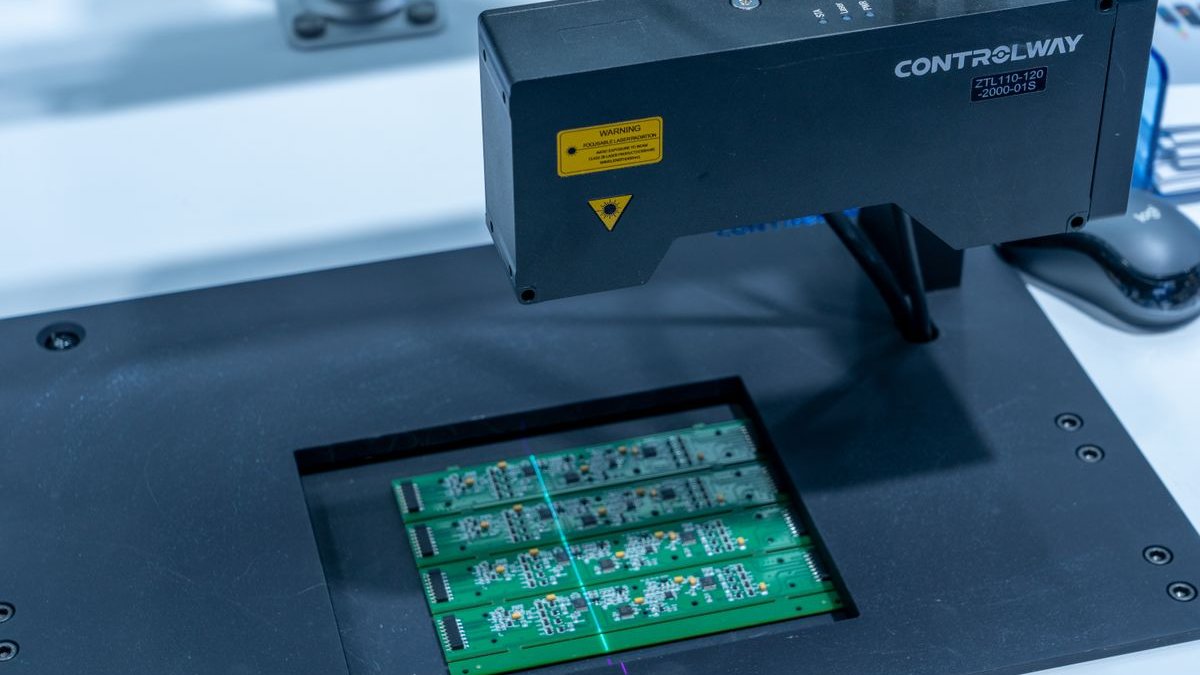
For decades, "sensor" on a plant floor mostly meant one of two things: a photoeye that says something is there or it isn't, or a proximity sensor that says something metal is close or it isn't. Both are cheap, reliable, and still the right call for a huge number of applications. But a growing share of the sensors going into new lines aren't binary at all — they're cameras that can actually see what's in front of them, and the market for that capability is growing a lot faster than most buyers spec'ing basic on/off sensors probably realize.
The market is growing faster than it looks
The global industrial machine vision market is on track to reach roughly $11.0 billion by the end of 2026, up from about $10.3 billion in 2025, according to Future Market Insights. That's a 6.9% compound annual growth rate projected to carry the market to an estimated $21.5 billion by 2036 — meaning the market is expected to roughly double over the next decade. Within that, smart camera-based systems are forecast to lead with about 58% share, and hardware overall is expected to hold roughly 64% of the market, which tells you this is still very much a physical-components story, not a pure-software one.
What a vision sensor actually does that a photoeye can't
The real difference isn't just "it has a camera in it." A simple photoelectric or proximity sensor answers one question — present or not present — and that's it. A vision sensor can evaluate shape, orientation, color, and presence or absence all in a single device, which means it can catch problems a binary sensor was never built to see: a part loaded backward, a label printed with the wrong lot code, a component that's the right shape but the wrong color, a fill line that's off by a few millimeters. Those are quality and process problems that used to require a person watching the line, or that simply got caught downstream — after the part had already moved on.
Why the U.S. may feel behind the curve
Adoption isn't even across regions. China is the fastest-growing country market for industrial machine vision at an 8.9% CAGR, followed by India at 8.2% and Germany at 7.6%, compared to 6.2% for the U.S., per Future Market Insights. That gap doesn't mean U.S. plants lack access to the technology — it likely reflects how much existing infrastructure is built around simpler sensors that still work fine for their original job. But it's a useful data point if a competitor's line is running tighter quality control than yours: the gap may not be labor or process, it may be sensor class.
Where this actually shows up on a line
The practical cases worth knowing about, in plain terms:
- Part orientation checks — confirming a component is loaded the correct way before it moves to the next station, not after.
- Print and label verification — reading a label to confirm it matches the product, not just that a label is present.
- Color sorting — separating parts or products by color where a proximity sensor simply can't tell the difference.
- Defect and completeness checks — catching a missing component, a cracked housing, or a misaligned assembly before it ships.
None of this replaces every photoeye or proximity sensor on a line — for a huge number of applications, a simple on/off sensor is still the right, most cost-effective answer. The point is knowing when the job actually calls for something that can see, not just detect.
How Stateside can help
If you're not sure whether a specific station on your line needs a basic photoeye or a real vision sensor, send us the application — what the part looks like, what could go wrong, and what "good" looks like — and we'll help you figure out which sensor class actually solves the problem instead of just adding cost.
Not sure if your application needs a vision sensor?
Tell us what the part is and what could go wrong — we'll help you spec the right sensor class for the job.
Talk to Our Team →