
Physical AI Is Making Industrial Robots Easier to Deploy
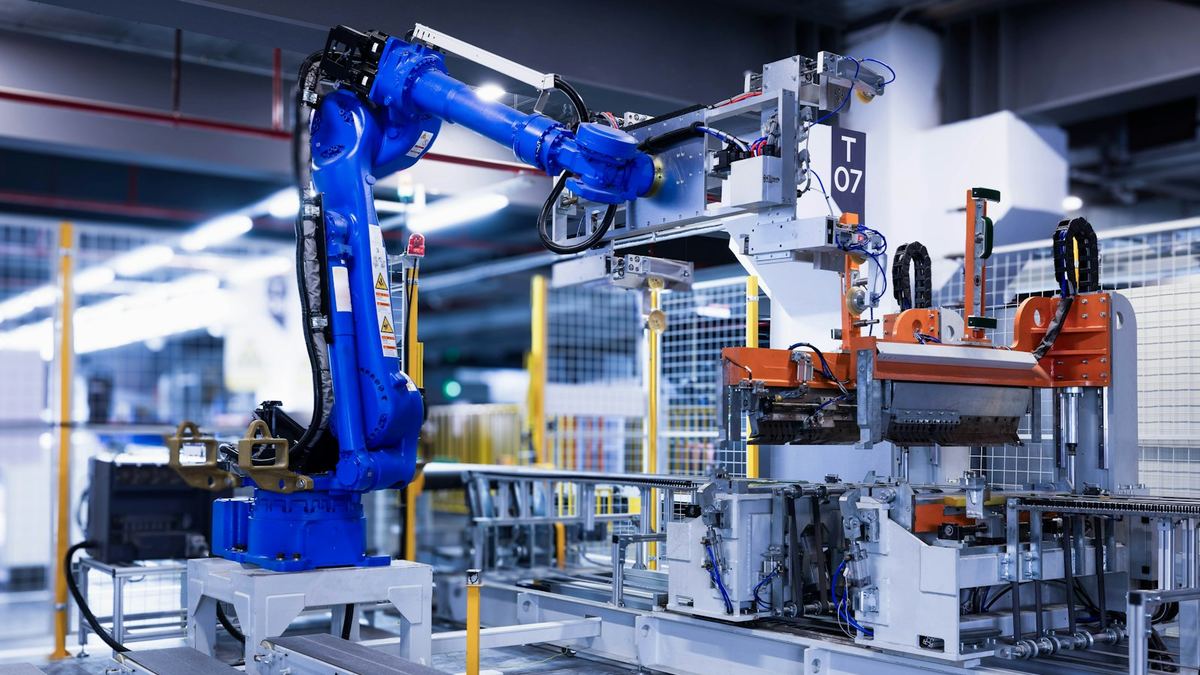
The biggest cost in most robot deployments was never the robot. It was the programming — the weeks of teaching an arm exactly where to move, exactly how hard to grip, exactly what to do if the part on the conveyor is a half-inch off from where it's supposed to be. "Physical AI" is the term now getting attached to a real shift in how that problem gets solved: robots that take in camera and sensor feedback in real time and adjust, instead of following a pre-taught routine step by step.
What actually changed
A traditional industrial robot is taught a fixed path — move here, close the gripper, move there — and it repeats that path exactly, which is exactly why it needs a caged cell, a precisely fixtured part, and a programmer's time every time the job changes. A physical-AI-enabled robot instead reads the actual scene in front of it and decides how to act on it, closer to how a person would handle a part that's not sitting perfectly in the jig.
Why deployment speed is the real story
The practical payoff shows up hardest in high-mix, low-volume production — exactly the kind of work that's historically been the worst fit for robotic automation, because the payback math never worked when reprogramming ate the time savings. A robot that can generalize from what it sees, instead of needing a fresh program for every new part, changes that math. It also means less specialized programming labor is needed on the floor to keep automation running as the job changes.
The broader context
This isn't happening in isolation. Roland Berger's 2026 industrial automation outlook points to this year as the first with real renewed growth momentum in the sector after a flat couple of years, with a realistic growth corridor of 6-7% through 2030. Easier-to-deploy robots and a market that's actively looking to grow again reinforce each other — physical AI lowers the barrier to a robotics project right as more manufacturers are looking to fund one.
Worth being clear-eyed about: physical AI doesn't eliminate integration work, and it's not a fit for every application — high-speed, fixed, single-task production still runs fine on a traditional taught path. Where it changes the calculus is everywhere the job changes often enough that reprogramming was the thing killing the ROI.
Sources
Speccing sensors or vision for a flexible automation cell?
We carry vision, proximity, and photoelectric sensing across the line card — send us the application and we'll help you spec it.
Talk to Our Team →